We know — because we read every competitor label we could find before we built our own formula.
Here's what most brands won't tell you: removing sulfates from a formula is the easy part. What replaces them is the part that actually matters — and most "sulfate-free" products never answer that question honestly.
What we discovered developing NOWATA:
Some brands swapped SLS for equally aggressive surfactants with less recognizable names
Others removed sulfates and quietly sacrificed cleaning performance
Almost none replaced the mechanism — just the ingredient
Sulfate-free on a label means sodium lauryl sulfate (SLS) and sodium laureth sulfate (SLES) are absent. It does not automatically mean gentler. It does not automatically mean safer. It does not automatically mean better for your family's skin.
That depends entirely on what the brand built instead.
We didn't remove sulfates and stop there. We replaced the entire cleansing mechanism — with a plant-based clumping technology that physically removes 99.9% of germs without any surfactant aggression at all.
On this page: what “sulfate-free” actually means on a label, what to look for beyond the claim, and what a genuinely gentle sulfate free hand soap formulation looks like when it’s built for your children first.
TL;DR Quick Answers
sulfate free hand soap
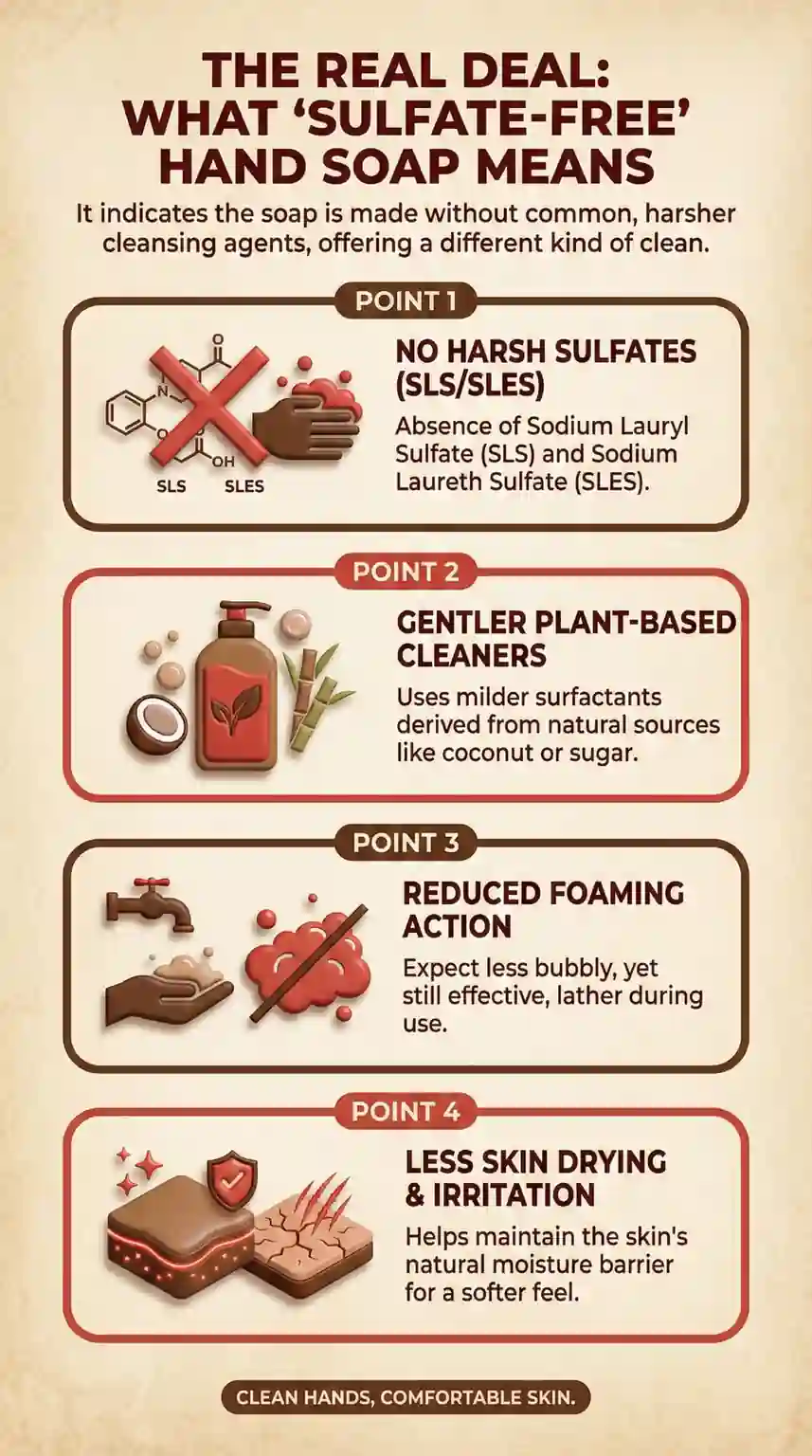
Sulfate-free hand soap is a formula made without sodium lauryl sulfate (SLS) or sodium laureth sulfate (SLES) — the synthetic surfactants responsible for stripping the skin's natural moisture barrier while creating lather.
What most brands won't tell you:
"Sulfate-free" has no FDA definition and requires no pre-market testing
Most sulfate-free formulas replace SLS with a different surfactant using the same stripping mechanism
Removing sulfates is the right starting point — what replaces them determines whether the formula actually protects your skin
What genuinely sulfate-free hand soap should deliver:
A cleansing mechanism that removes contaminants without disrupting the skin barrier
Full ingredient transparency — not just front-label claims
Third-party verified performance data
What we built at NOWATA: a 100% plant-based formula using clumping technology that physically lifts dirt, oil, and germs away from skin — no sulfates, no surfactant aggression, no sink required. Independent Swiss lab testing confirmed 99.9% germ removal.
The bottom line: sulfate-free matters. But the mechanism that replaces sulfates matters more.
Top Takeaways
Here's what every family should walk away knowing after reading this page.
"Sulfate-Free" Is a Starting Point — Not a Solution.
Removing SLS is the right call — not a complete answer
The question that matters: what replaced it, and was it tested?
Most brands never answer that — we do
The FDA Cannot Verify "Sulfate-Free" Before It Hits Shelves.
No federal definition exists for "sulfate-free," "gentle," "natural," or "clean"
No required testing standard — no pre-market approval process
These claims reach shelves on a marketing decision alone
Read the ingredient list — not the front label — to know what's actually in the formula
Nearly 1 in 7 People Will Develop Chronic Hand Eczema. For Many, the Soap Is the Problem.
National Eczema Association puts lifetime prevalence at 14.5% of the general population
Most were never told surfactant-based cleansers contribute to barrier damage
Many are using "gentle" formulas that still strip the skin barrier
Sensitive skin is often a formulation problem in disguise
Hand Dermatitis Is the Second Most Common Nonfatal Occupational Illness in the U.S.
CDC confirmed this ranking in 2020
Primary aggravating factor: frequent handwashing
Most at risk: healthcare workers, teachers, parents, food service workers
Effective hygiene and an intact skin barrier are not opposing goals — they only look that way when the formula was never designed to serve both
We Built NOWATA Because the Formula Our Children Needed Didn't Exist.
Two doctors. Two years of formulation. One Swiss lab test.
Result: 99.9% germ removal — zero sulfates, zero surfactant aggression
Built around physical contaminant removal — not chemical stripping
Works without a sink — protects the skin barrier — holds itself to a standard higher than the law requires
Sulfate-free means one thing precisely: the formula contains no sodium lauryl sulfate (SLS) or sodium laureth sulfate (SLES).
That's it.
It does not mean:
The formula is fragrance-free
The formula is paraben-free
The formula is gentle on skin
The formula is more effective at removing germs
The formula has been independently tested for safety
What it does mean:
The primary foaming surfactant has been removed
Something else is doing the cleansing work
That "something else" is what you actually need to investigate
The claim tells you what's missing. It tells you nothing about what's there.
Why Sulfates Were in Your Soap in the First Place
Sulfates became the industry standard for one reason: they work cheaply and at scale.
SLS and SLES are synthetic surfactants derived from sulfuric acid and fatty alcohols. In hypoallergenic hand soap, they break surface tension between oil and water — lifting dirt, bacteria, and grease off skin efficiently. They also produce the dense lather most consumers equate with cleanliness.
The problem was never that sulfates don't work. The problem is what they can't distinguish between:
The grime on your child's hands — and the natural oils protecting their skin
Effective cleansing — and barrier stripping
Getting clean — and getting damaged
When we traced our children's cracked, irritated hands back to SLS, we didn't just remove the ingredient. We questioned the entire cleansing model it represented.
What Brands Typically Replace Sulfates With
This is the part most "sulfate-free" labels leave unanswered.
Common sulfate replacements:
Cocamidopropyl betaine — a milder amphoteric surfactant, but a known allergen for some skin types
Sodium cocoyl isethionate — gentler than SLS, still a synthetic surfactant
Decyl glucoside — plant-derived, mild, widely considered one of the safer options
Sodium lauroyl sarcosinate — mild but still capable of irritation at higher concentrations
What to look for beyond "sulfate-free":
Are the replacement surfactants plant-derived or synthetic?
Is the full ingredient list published and independently verifiable?
Has the formula been tested — or just formulated without sulfates and labeled accordingly?
What we found reading competitor labels: Several products marketed as sulfate-free contained surfactant blends that were marginally less aggressive than SLS — but still fundamentally reliant on the same chemical stripping mechanism. Removing sulfates without replacing the mechanism isn't a solution. It's a label change.
How to Read a Sulfate-Free Label Accurately
Step 1 — Find the surfactant. It will be near the top of the ingredient list. Whatever is doing the cleansing work will appear in the first five ingredients.
Step 2 — Identify what replaced the sulfates. Look up unfamiliar ingredient names independently. EWG's Skin Deep database is a reliable starting point.
Step 3 — Check for unregulated claims. "Natural," "gentle," "clean," and "non-toxic" have no regulatory definition in personal care labeling. Sulfate-free does — but only in the narrowest sense.
Step 4 — Look for third-party verification. Has the formula been independently tested? By whom? Under what protocol?
Step 5 — Ask what the brand replaced sulfates with — and why. A brand confident in its formulation will answer that question clearly. If the answer isn't on the label or the website, that tells you something too.
What Genuine Sulfate-Free Formulation Actually Looks Like
We didn't set out to make a sulfate-free soap. We set out to make something our children could use safely — every day, everywhere.
What that required:
Questioning whether surfactant-based cleansing was the right model at all
Two years of formulation before a single batch went to Swiss laboratory testing
A physical removal mechanism that doesn't rely on chemical aggression
What genuine sulfate-free formulation delivers:
No SLS, SLES, or surfactant substitutes with equivalent irritation profiles
A cleansing mechanism built around contaminant removal — not barrier stripping
A full ingredient list that holds up to independent scrutiny
Performance data from third-party testing — not marketing claims
The label claim "sulfate-free" was never the goal. Clean, safe, effective hands were. The label just describes what we didn't need to include to get there.
The One Question Every Sulfate-Free Label Should Answer
What replaced the sulfates — and why is it better?
If a brand can't answer that question clearly on their label, their website, or in their formulation story — the "sulfate-free" claim is doing more work for their marketing than it is for your family's skin.
We answer it this way:
We replaced sulfates with a plant-based clumping technology that physically binds to dirt, oil, and germs — then lifts them away entirely without water, rinsing, or surfactant aggression.
That's not a label claim. That's a mechanism. And it's the difference between removing sulfates from a formula and replacing the reason they were there.
"When we started reading sulfate-free labels during NOWATA's development, we expected to find better formulas. What we found instead were better marketing departments. Removing SLS from an ingredient list is a five-minute decision. Building a formula that doesn't need it — one that removes germs more completely, protects the skin barrier, and works without a sink — took us two years. That gap between the label claim and the actual formulation work is exactly where most families get misled. We built NOWATA to close it."
Essential Resources
When we started developing NOWATA, we didn't take the industry's word for anything. We went straight to the source — government databases, peer-reviewed clinical research, and independent ingredient verification tools. These are the seven resources that shaped how we read labels, evaluate ingredients, and make formulation decisions. We think every family should have them.
1. FDA: Why "Sulfate-Free" on a Label Doesn't Mean What Most People Think Here's something the industry counts on you not knowing: "sulfate-free" is not an FDA-approved designation. Neither is "gentle." Neither is "natural." This official FDA resource explains exactly what personal care labels are legally required to say — and more importantly, what they're not. We read this before we wrote a single word on our own label. Source: U.S. Food and Drug Administration URL: https://www.fda.gov/cosmetics/cosmetics-labeling/cosmetics-labeling-claims
2. FDA: The One Labeling Rule That Actually Protects You FDA regulations require cosmetic ingredients to be listed in descending order of concentration. That means the first five ingredients tell you most of what you need to know about any formula — including whether a "sulfate-free" claim holds up past the front of the bottle. This step-by-step labeling guide is the foundational skill for reading any hand soap label accurately. Source: U.S. Food and Drug Administration URL: https://www.fda.gov/cosmetics/cosmetics-labeling-regulations/cosmetics-labeling-guide
3. EPA: The Government's Own Evidence on What SLES Leaves Behind When we investigated whether SLES was a safe swap for SLS, this is where the research took us. The EPA's formal risk evaluation documents 1,4-dioxane — a manufacturing byproduct generated during SLES ethoxylation — as a confirmed contaminant in consumer soaps and detergents. This isn't a fringe concern. It's the government's own finding. It's one of the reasons we eliminated sulfates entirely rather than substituting one for another. Source: U.S. Environmental Protection Agency URL: https://www.epa.gov/assessing-and-managing-chemicals-under-tsca/risk-evaluation-14-dioxane
4. EPA: What the Government Is Actually Doing About 1,4-Dioxane Right Now The EPA isn't just studying 1,4-dioxane — it's actively managing the risk. This resource details current regulatory actions addressing 1,4-dioxane's confirmed presence in consumer personal care products. For any family evaluating whether SLES is genuinely safer than SLS, this is the most current government evidence available — and it raises questions most "sulfate-free" brands aren't answering. Source: U.S. Environmental Protection Agency URL: https://www.epa.gov/assessing-and-managing-chemicals-under-tsca/risk-management-14-dioxane
5. EWG Skin Deep: The Independent Tool We Recommend for Every Formula — Including Ours EWG's Skin Deep database cross-references over 130,000 personal care products and their ingredients against nearly 60 toxicity and regulatory databases — and returns plain-language hazard scores any parent can act on. We encourage every family to look up any soap they use here. Including NOWATA. Transparency isn't something we ask you to take on faith. It's something we invite you to verify. Source: Environmental Working Group URL: https://www.ewg.org/skindeep/
6. NIH/PubMed: The Molecular Evidence for What SLS Actually Does Inside the Skin Barrier When our children's hands cracked after every wash, we needed more than anecdotal evidence. This peer-reviewed clinical study documents how surfactants like SLS disorganize the intercellular lipid structure of the stratum corneum at the molecular level — confirming that barrier disruption is a measurable structural event, not a marketing claim. This is the science that convinced us removing sulfates wasn't enough. We needed to replace the mechanism entirely. Source: National Institutes of Health — PubMed URL: https://pubmed.ncbi.nlm.nih.gov/28922453/
7. NIH/PubMed: Why Post-Wash Dryness and Tightness Is a Formulation Problem — Not a Skin Problem This is the study we point to when parents tell us their child just has sensitive skin. Controlled clinical research directly investigating SLS irritation found that dryness, tightness, and roughness involve both surfactant binding and lipid disruption in the stratum corneum. The irritation your family experiences after washing isn't inevitable. It's avoidable. And the evidence was peer-reviewed and published long before we built NOWATA. Source: National Institutes of Health — PubMed URL: https://pubmed.ncbi.nlm.nih.gov/1963606/
Like comparing top flooring options beyond the surface finish, these seven trusted resources show you how to look past “sulfate-free” marketing and verify what’s actually in a formula—so your family gets genuinely gentle, evidence-backed hand soap.
Supporting Statistics
We read a lot of studies before we made a single batch of NOWATA. Clinical research. Government data. Peer-reviewed findings on skin barrier disruption, surfactant chemistry, and occupational skin disease. We thought the data would confirm what we already suspected. What we didn't expect was how much it would change the questions we were asking.
These are the four statistics that shifted our thinking — and why they matter to every family reading a "sulfate-free" label.
Stat 1: Nearly 1 in 7 People Will Develop Chronic Hand Eczema in Their Lifetime. Most Will Never Trace It Back to Their Soap.
The National Eczema Association estimates the lifetime prevalence of chronic hand eczema at 14.5% of the general population. Nearly 1 in 7 people. Not occasional dryness. Chronic, recurring, clinically documented barrier damage — on the most soap-exposed surface of the human body.
When we saw this number, we didn't think about market opportunity. We thought about our own children's hands.
What the statistic doesn't capture:
How many of those 14.5% were told they just have sensitive skin
How many bought fragrance-free versions of the same formula
How many never connected the damage to the ingredient causing it — because the label never told them
What two years of formulation taught us: chronic hand eczema isn't inevitable. For a significant percentage of that 14.5%, it's a formulation problem wearing a skin condition diagnosis.
Stat: Lifetime prevalence of chronic hand eczema estimated at 14.5% of the general population
Source: National Eczema Association — Eczema Facts
Stat 2: In 2020, Hand Dermatitis Was the Second Most Common Nonfatal Occupational Illness in the U.S. The Cause Isn't What Most People Assume.
CDC data confirmed hand dermatitis ranked as the second most common nonfatal occupational illness in the United States in 2020. The CDC identified frequent handwashing — more than 20 times per day — as one of the primary aggravating factors.
We've talked to enough parents, teachers, and nurses to know what that number feels like in practice:
The pediatric nurse who keeps prescription cream in her locker
The kindergarten teacher whose knuckles crack every January
The parent who calls the damage their "winter skin" and never questions the soap
The insight the data pointed us toward: the handwashing protocol that protects people is the same protocol damaging the hands of the people performing it. That's not a fringe edge case. That's the second most common nonfatal occupational illness in the country, and eco-friendly soap supports a smarter standard for clean hands that’s better for people and the planet.
When we designed NOWATA's clumping mechanism, we were thinking about those people specifically. After two years of formulation, we know effective hand hygiene and an intact skin barrier are not opposing goals. They only look that way when the formula was never designed to serve both.
Stat: Hand dermatitis was the second most common nonfatal occupational illness in the U.S. in 2020; frequent handwashing identified as a primary aggravating factor
Source: CDC — Keeping Your Hands Clean and Healthy
URL: https://blogs.cdc.gov/safehealthcare/keeping-your-hands-clean-and-healthy/
Stat 3: NIOSH Reports Contact Dermatitis Accounts for 90–95% of All Occupational Skin Disease in the U.S. Among the Named Causes: Water, Detergents, and Weak Cleaning Agents.
NIOSH — the National Institute for Occupational Safety and Health — identifies contact dermatitis as 90 to 95% of all occupational skin diseases in the United States. Among the mild irritants named as causes:
Water
Detergents
Weak cleaning agents
Not industrial solvents. Not rare sensitizers. The two things present in every conventional handwashing interaction.
What the industry's response has been: better lather, milder surfactants, added moisturizers. What that response is doing: treating the symptom, not the cause.
Our response was different. We asked whether surfactant-based cleansing was the right mechanism at all. Two years later:
Swiss lab testing confirmed 99.9% germ removal
Zero sulfates
Zero surfactant aggression
The NIOSH data told us something the industry hadn't acted on. We did.
Stat: Contact dermatitis constitutes 90–95% of all occupational skin disease in the U.S.; mild irritants including water, detergents, and weak cleaning agents are among the identified causes
Source: CDC/NIOSH — About Skin Exposures and Effects
URL: https://www.cdc.gov/niosh/skin-exposure/about/index.html
Stat 4: The FDA Has No Authority to Approve Cosmetic Claims Before Products Reach Store Shelves — Including Every "Sulfate-Free" Label on the Market.
The FDA's own regulatory guidance confirms it has no pre-market approval authority over cosmetic claims. That means every "sulfate-free," "gentle," "natural," and "clean" label claim reaches the shelf without:
Any federal verification
A required testing standard
A regulatory definition behind it
We didn't learn this from a legal brief. We learned it from reading competitor labels during the eighteen months before we launched.
What the statistic actually points to: "sulfate-free" on a label tells you only one thing — what's absent. It says nothing about:
What replaced the sulfates
How the replacement performs
Whether anyone tested it before it went to market
When we pursued independent Swiss lab testing for NOWATA's germ removal claims, we weren't satisfying a legal requirement. There isn't one. We were closing a gap the FDA itself acknowledges exists. Because if we were building this for our own kids, "no legal obligation to prove it" was never going to be the standard we held ourselves to.
Stat: The FDA does not have authority to approve cosmetic claims — including "sulfate-free" — before products reach market
Source: FDA — Cosmetics Labeling Claims
URL: https://www.fda.gov/cosmetics/cosmetics-labeling/cosmetics-labeling-claims
Final Thought & Opinion
Our honest opinion after two years of formulation, eighteen months of reading competitor labels, and a combined thirty-plus years of clinical and biomedical training:
The "sulfate-free" movement got the diagnosis right and the treatment wrong.
Identifying sulfates as a problem was the right call. Science supports it. The NIOSH data supports it. The 14.5% chronic hand eczema prevalence supports it. What happened next was a marketing response dressed up as a formulation solution.
We watched it happen from the inside.
What We Saw Reading Competitor Labels
During the eighteen months before NOWATA launched, we read every sulfate-free hand soap label we could find. We were looking for one thing: evidence that brands had replaced the mechanism, not just the ingredient.
What we found instead:
Surfactant swaps with marginally lower irritation profiles but identical cleansing logic
"Natural" and "plant-based" claims applied to ingredients that still strip the skin barrier
No third-party performance data — anywhere
Marketing language filling the space where formulation transparency should be
We weren't surprised. We had already exhausted every "gentle" and "sensitive" option on the shelf for our own children. We had lived the gap between what the labels promised and what the formulas delivered.
That gap is what NOWATA exists to close.
What the Research Couldn't Tell Us
The NIH studies confirmed SLS disrupts the skin barrier at the molecular level. The CDC confirmed hand dermatitis is the second most common nonfatal occupational illness in the country. The NEA confirmed nearly 1 in 7 people will develop chronic hand eczema in their lifetime.
What the research couldn't tell us:
What it feels like to watch your child wince at the sink every morning
What it feels like to be a physician who understands the mechanism — and can't find a formula that fixes it
What it feels like to take two years building something from scratch, send it to a Swiss lab, and see 99.9% germ removal on a formula with zero sulfates and zero surfactant aggression
That last part mattered more than we expected. Not because it validated our chemistry. Because it validated the question we asked in the first place: what if effective and gentle were never actually opposites? What if the industry just never had a reason to prove it? Top flooring trends prove the same principle: performance and comfort can be designed together.
Our Opinion on Where This Goes
We believe the "sulfate-free" label is currently doing more work for marketing departments than for families. Not an accusation. A structural problem. When a claim requires no federal verification, no required testing, and no regulatory definition, the label fills with intention — not evidence.
Here's where we land after everything we've learned:
Sulfate-free is necessary but not sufficient. Removing SLS is the right starting point — not a complete solution. What replaces it, and whether it was actually tested, is the question every family should be asking.
The skin barrier is not a trade-off. The idea that effective cleansing requires barrier disruption is an industry assumption, not a scientific conclusion. We built a formula that challenges it. The lab data backs it up.
Transparency is not a marketing strategy. It's a baseline obligation. Every NOWATA ingredient is published and independently verifiable. Not because we're required to. Because families reading labels at 11pm trying to figure out why their child's hands won't heal deserve that minimum.
Waterless hygiene is a public health opportunity the industry hasn't taken seriously. The CDC says effective handwashing requires 20 seconds at a sink. Access to a sink is the single biggest barrier to consistent hand hygiene in real life. A formula that cleans without water doesn't just protect one family — it changes what clean hands can mean for healthcare workers, teachers, and kids who need hygiene options that fit how they actually live.
The Bottom Line
We are not neutral observers of the hand soap industry. We are two doctors who got frustrated enough to build something better — and transparent enough to tell you exactly why.
What the data told us:
The industry wasn't asking the right questions
Most brands weren't interested in answering them
The answers were available to anyone willing to start over from the right place
"Sulfate-free" should mean the barrier disruption problem has been solved — not sidestepped with a cleaner-sounding ingredient. It should mean the formula was tested, the claims are verified, and the family reading the label can trust what isn't there as much as what is.
FAQ on Sulfate Free Hand Soap
Q: What does "sulfate-free" actually mean on a hand soap label?
A: Less than most families think.
What it legally confirms:
SLS and SLES are absent
Nothing else
What it doesn't confirm:
What replaced them
Whether the replacement was tested
Whether any claim was reviewed before the product hit shelves
What we learned building NOWATA: we spent eighteen months reading every sulfate-free competitor label we could find. What we kept seeing:
One surfactant removed
Another surfactant added with a less recognizable name
Same stripping mechanism — cleaner-sounding label
Our conclusion: "sulfate-free" tells you what's missing. It tells you nothing about whether the problem was actually solved.
Q: Is sulfate-free hand soap actually more effective at removing germs?
A: It depends entirely on what replaced the sulfates.
The three cleansing models:
Conventional soap: chemically strips contaminants using surfactant aggression
Most sulfate-free formulas: same stripping logic — different surfactant name
NOWATA: plant-based clumping technology that physically binds to contaminants and lifts them away — no surfactant, no stripping, no sink required
What two years of formulation taught us:
CDC data confirms technique drives germ removal — not surfactant strength
We built a mechanism around that finding — not around what was already on the shelf
Swiss lab result: 99.9% germ removal, zero sulfates, zero surfactant aggression
We didn't compromise effectiveness to remove the irritant. We found a mechanism that didn't require us to choose.
Q: Who is most at risk from sulfates in hand soap — and how do they know?
A: Anyone washing regularly is exposed. The people we think about most when we formulate:
Children with eczema-prone skin washing before every meal
Healthcare workers exceeding 20 handwashes per day
Teachers and food service workers with near-constant soap exposure
Parents handling bottle prep and diaper changes around the clock
How most people find out — not from a label:
Cracked knuckles every January
A child who cries at the sink
A dermatologist visit ending with a prescription and no discussion of the soap causing the problem
What the data confirms:
CDC ranked hand dermatitis as the second most common nonfatal occupational illness in 2020
NEA puts chronic hand eczema lifetime prevalence at 14.5% of the general population
We heard versions of these statistics in parent stories during development — we had lived our own version before we ever saw the numbers
Q: What should I look for — and watch out for — on a sulfate-free hand soap label?
A: Start with the first five ingredients. That's where most of the formula lives.
Look for:
A cleansing agent with an independently verified safety profile
Third-party performance data on the label or brand website
Complete ingredient transparency — no exceptions
Watch out for:
SLS replacements with similar irritation profiles: cocamidopropyl betaine, sodium cocoyl isethionate, sodium lauroyl sarcosinate
SLES listed anywhere — EPA confirms a 1,4-dioxane contamination risk from the ethoxylation process
Unregulated front-label claims: "natural," "gentle," "clean," and "plant-based" carry no FDA definition
Any brand that can't clearly answer: what replaced the sulfates and why is it better?
What we did: held ourselves to that last question before putting a single claim on NOWATA's label. If we couldn't answer it clearly — the formula wasn't ready.
Q: Why did two doctors create a sulfate-free hand soap — and what makes NOWATA different?
A: We exhausted every formula on the market for our own children. None of them solved the right problem.
What most sulfate-free soaps solve:
SLS removed from the ingredient list — nothing more
What NOWATA solves that no other formula addresses together:
Mechanism — physical contaminant removal through plant-based clumping technology; no surfactant stripping, no barrier cost
Access — no sink required; clean hands shouldn't depend on proximity to running water
Verification — independent Swiss lab testing pursued because we were building this for our own kids — not because the law required it
What that delivers:
100% plant-based
Zero sulfates, parabens, and alcohol
99.9% germ removal — third-party verified
80–100 uses per tube
No rinse, no surfactant damage, no sink
We didn't start with a product concept. We started with a problem we couldn't solve any other way. The formula that didn't exist for our children is the formula we built. Everything else followed from that.